Where to Eat in Rome Without the Tourist Traps — a Local's Map
Where to eat in Rome like a local: the neighborhoods to aim for, the trap zones to skip by the Trevi, Vatican and Spanish Steps, and how to eat well for less.
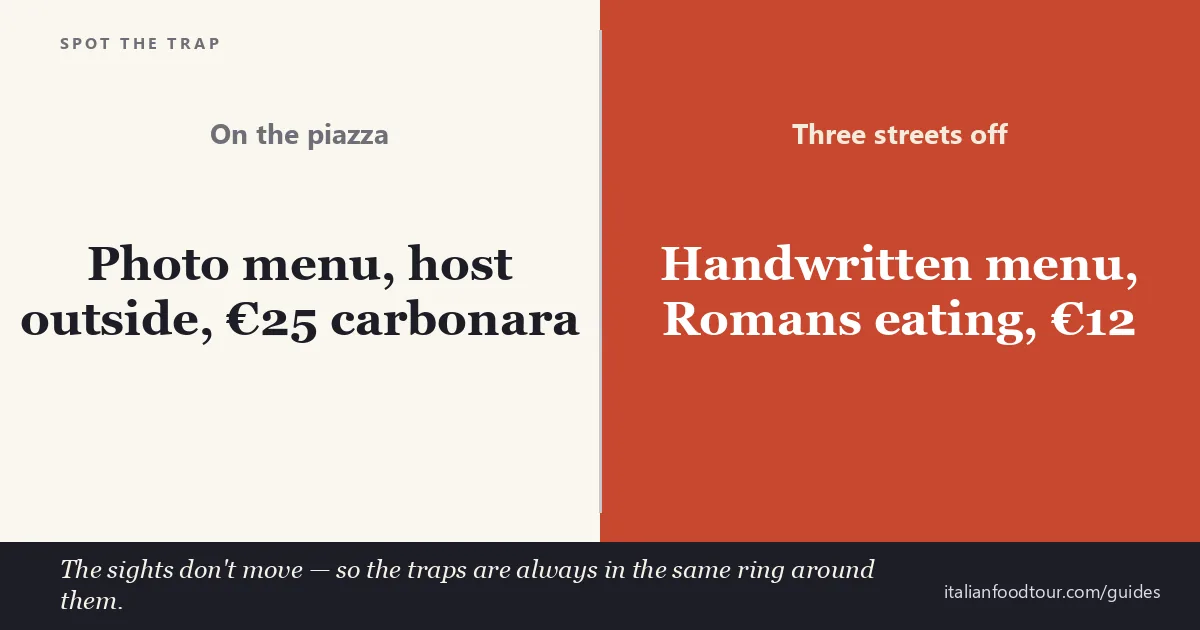
Here’s the single most useful thing I can tell you about eating in Rome, and it’s not a restaurant name: the tourist traps cluster exactly where the sights are. The terrible €25 carbonara is the one with a photo menu, a host waving you in, and a view of the monument. Walk three streets off that piazza — genuinely, three streets — and the same dish is €12, better, and full of Romans. Master that one move and you don’t need a list. But let me give you the map anyway.
The trap, and how to read it in five seconds
Before the neighborhoods, the pattern. A place is cooking for tourists when it has: a menu with photos, a menu in six languages, a host outside beckoning you in, tables directly facing a major sight, and prices that don’t make you blink. A place is cooking for Romans when it has: a short, handwritten or daily menu, no host (you walk in and wait), it’s a street or two off the famous square, and there are actual Italians eating there at 2pm. That’s the whole test. The sights don’t move, so the traps are always in the same predictable ring around them.
By the big sights: skip the ring, walk to the real thing
Trevi Fountain. The cafés circling it are pure markup. Walk uphill toward Monti — the warren of lanes between the Fountain and the Colosseum that’s quietly one of central Rome’s best eating-and-drinking neighborhoods, full of Romans, wine bars, and trattorie that don’t need your tour bus.
Spanish Steps. Via dei Condotti is for shopping, not eating — the restaurants here charge Spanish Steps rent. Drift toward the streets around Piazza di Spagna’s edges and up toward the Villa Borghese side, or honestly, just plan to eat elsewhere; this is the weakest food zone in the centre.
Pantheon & Piazza Navona. Beautiful squares, brutal restaurants — anything with tables on Navona itself is a trap. Duck into the vicoli (the tangle of side lanes) between here and Campo de’ Fiori, or head a few minutes south to the Jewish Ghetto (below).
The Vatican & St. Peter’s. The worst trap zone in the city — Borgo Pio looks charming and cooks for the crowd. The fix is simple and few tourists make it: cross into Prati, the elegant residential grid right behind the Vatican walls, where the people who work near St. Peter’s actually eat. The Trionfale market nearby is one of Rome’s great food markets.
The Jewish Ghetto (Sant’Angelo). The exception to “central = bad.” This tiny, ancient quarter is genuinely excellent — it’s the home of Roman-Jewish cooking, and the carciofo alla giudia (the flattened, deep-fried artichoke) is a thing you cross the city for. Stick to the side streets over the busiest stretch and you’re golden.
Trastevere. The famous answer, with a catch. The picture-perfect squares — Santa Maria in Trastevere, Piazza Trilussa — are ringed with tourist menus. The neighborhood is still wonderful; you just have to walk into it, away from the squares and toward the quieter vicoli and the Viale Trastevere side, where the trattorie are real.
The neighborhoods to just aim for
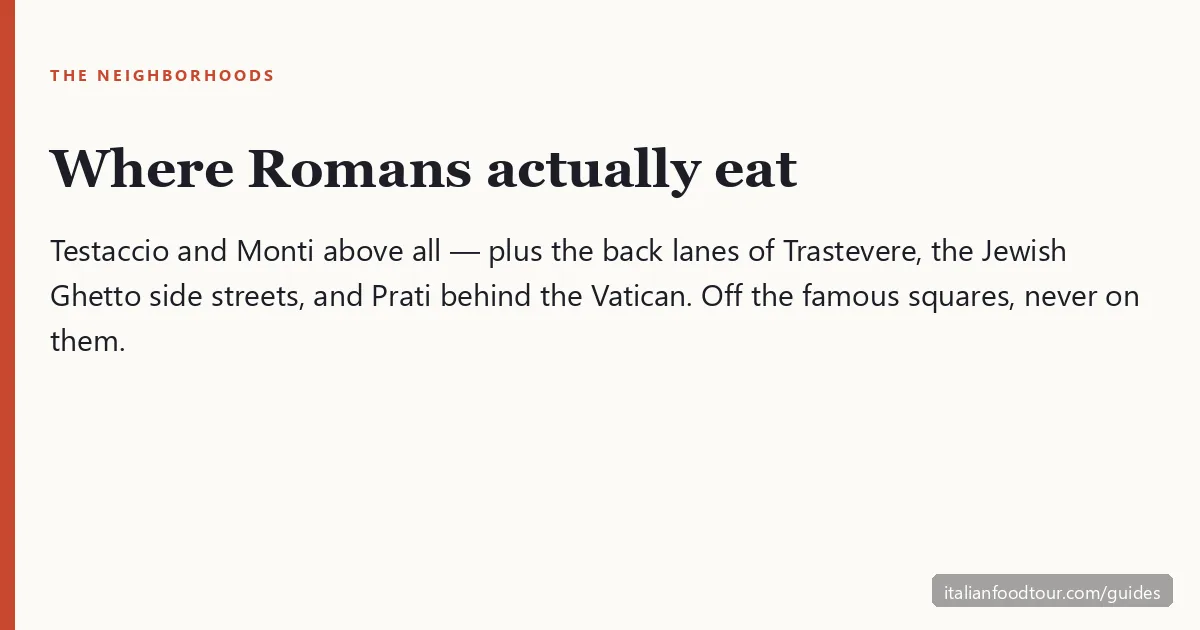
If you’d rather skip the sight-by-sight calculus, point yourself at one of these and eat almost anywhere:
- Testaccio — the answer to “where do locals eat in Rome.” A working-class food neighborhood built around its market and the old slaughterhouse, the spiritual home of Roman quinto quarto (offal) cooking and some of the city’s best, least-touristy trattorie.
- Monti — central, gorgeous, and full of Romans. The easiest “good food near the sights” win.
- Prati — residential, polished, behind the Vatican. Where you eat well near St. Peter’s.
- Trastevere back lanes and the Ghetto side streets — as above.
Eat well and pay local prices
Avoiding the trap is half of it; ordering right is the other half. Rome’s best food is also its cheapest because everyone makes it well: cacio e pepe, carbonara, amatriciana (€10–14 in a real trattoria, not €22 on the piazza); supplì (the fried rice croquette) and pizza al taglio (by the weight) for a couple of euros standing up; carciofi alla giudia in the Ghetto. The €25 “tourist risotto” next to the monument is exactly the dish to not order — it’s where the markup hides. (For the full rundown of what to order — the four Roman pastas, the street food, breakfast — see what to eat in Rome; for the rules on the rest of the meal, the Italian restaurant etiquette guide and do you tip in Italy.)
The honest shortcut
You can navigate all of this yourself — or you can let a Roman do it for you on day one. That’s exactly what a Rome food tour is: a local walks you off the piazza, into Testaccio or the Ghetto or the real Trastevere, and points at the thing you should actually order, at the price it should actually cost. One afternoon, and the rest of your trip’s meals sort themselves out — you’ll already know which streets to turn down and which menus to walk past.
The traps are loud and easy to find. The good stuff is quiet and three streets away. Now you know where to look.
Where to Eat in Rome — Quick Answers
The neighborhoods to aim for and the trap zones to skip.
Testaccio and Monti above all, plus the back lanes of Trastevere and the side streets of the Jewish Ghetto and Prati. As a rule: off the famous squares, not on them.
Testaccio and Monti for the most reliably good, least-touristy food; the Jewish Ghetto for Roman-Jewish classics like carciofi alla giudia; plus Trastevere's back lanes and Prati behind the Vatican. The one constant: eat off the famous squares, not on them.
Near the Vatican, cross into Prati. Near the Trevi, walk up to Monti. Near the Spanish Steps, plan to eat elsewhere — it's the weakest food zone in the centre.
The main squares are; the neighborhood isn't. Walk away from Santa Maria in Trastevere and Piazza Trilussa into the quieter lanes and the trattorie get real.
It's a beautiful, lantern-lit medieval quarter packed with trattorie — which is exactly why its main squares have gone touristy. The neighborhood deserves the love; you just have to walk a few streets into the quieter lanes to find the real food.
Skip anywhere with a photo menu, a host outside, or tables facing a major sight. Walk two or three streets off the square, look for a short handwritten menu and Romans actually eating there.
Order the Roman classics — cacio e pepe, carbonara, supplì, pizza al taglio — in a real neighborhood trattoria. They're €10–14 a plate, and the best thing on the menu.
Still have questions? Email us at info@italian-food-tour.com
Skip the Traps — Eat Where Romans Eat
The surest way past the tourist menus is to start with a local. A small-group Rome food tour walks you off the piazza into Testaccio, Trastevere's back lanes, or the Jewish Ghetto — the real food, at real prices. Free cancellation.
Browse Rome Food Tours