What to Eat in Rome — The Dishes That Actually Matter (Not the Tourist Menu)
What to eat in Rome, from a local's plate: the four classic Roman pastas, the cheap street food worth crossing town for, breakfast, and what to skip.
If you only remember one thing about eating in Rome, make it this: Rome is a pasta-and-offal town, not a “pasta and pizza” one, and its best food is also its cheapest. The dish that defines this city — cacio e pepe, three ingredients, no sauce in the bottle — costs about €10 in a real trattoria and is better than almost anything twice the price on a piazza. So the question isn’t where’s the fancy restaurant. It’s what’s the thing this place actually does well — and in Rome, that thing is gloriously specific.
Here’s what I’d tell a friend landing tomorrow: what to order, what to seek out beyond the obvious, and the one dish to stop ordering.
Start here: the four Roman pastas
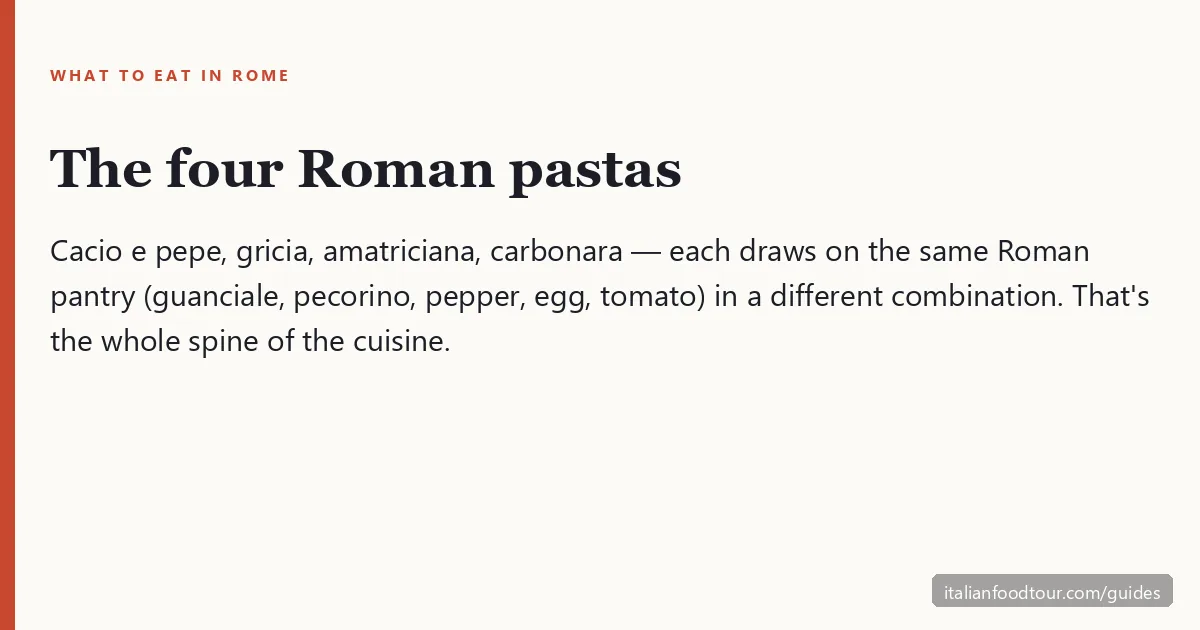
Romans will argue about a lot, but not about this — there are four classic Roman pastas, and they’re all drawn from the same small Roman pantry: guanciale (cured pork jowl, not pancetta and absolutely not bacon), pecorino romano (sharp sheep’s cheese, not parmesan), black pepper, egg, and tomato. Each pasta uses a different subset of those five — that’s the whole trick. Learn these four and you’ve learned the spine of the cuisine.
- Cacio e pepe — the purest. Just pecorino, black pepper, and starchy pasta water emulsified into a cream. No actual cream. When it’s done right it’s silk; when it’s done lazily it’s a clumpy mess, which is exactly why it’s a great test of a kitchen.
- Gricia — the “white amatriciana”: guanciale and pecorino, no tomato. The oldest of the four, and the one tourists never order because they’ve never heard of it. Order it and you’ve sent a signal.
- Amatriciana — gricia plus tomato. Guanciale, tomato, pecorino, a little chili. In Rome it’s served with bucatini (the thick hollow spaghetti) or rigatoni; the dish’s home town of Amatrice insists on spaghetti — a fight you don’t need to pick.
- Carbonara — egg yolk, pecorino, guanciale, pepper. No cream, ever — the silkiness is egg and cheese, not dairy from a tub. Cream in carbonara is the single clearest “cooked for tourists” tell in the city.
Order any of these in a proper neighborhood trattoria and you’re eating the real Rome for €10–14. (For where those trattorie are — and which piazzas to avoid — see where to eat in Rome.)
Beyond pasta and pizza — the stuff Romans actually snack on
This is the autocomplete question everyone types — what to eat in Rome besides pasta and pizza — and it’s the best one, because the answer is where the city gets fun and cheap.
- Supplì — the Roman fried rice croquette: risotto-style rice with ragù, a molten mozzarella core. Pull it apart and the cheese stretches like a phone cord — the classic ones are called supplì al telefono. A euro or two, eaten standing up. (It’s the Roman cousin of Sicilian arancini, and Romans will defend the difference to the death.)
- Carciofi — the artichoke, in two forms. Alla romana is braised flat with garlic and mentuccia (Roman wild mint); alla giudia is the showpiece — a whole artichoke deep-fried until the leaves crisp into a bronze flower, a Roman-Jewish dish you cross the city to the Ghetto for. Peak season is roughly February to April.
- Pizza al taglio — pizza by the weight, cut from big rectangular trays, eaten folded and standing. Different animal from a sit-down round pizza; this is lunch on your feet for a few euros. (And Roman round pizza, when you do sit, is thin and cracker-crisp — the opposite of soft Neapolitan.)
- Fritti — the fried starters that open a Roman pizzeria meal: fiori di zucca (zucchini flowers stuffed with mozzarella and anchovy, battered and fried), filetti di baccalà (fried salt-cod fillets), and supplì again.
- Quinto quarto — the “fifth quarter,” Rome’s offal tradition, born in the Testaccio slaughterhouse district: coda alla vaccinara (oxtail braised in celery and tomato), trippa alla romana (tripe), rigatoni con la pajata. Adventurous, deeply Roman, and the soul of the Testaccio trattorie.
Breakfast, sweets, and the summer thing
Roman breakfast is small and sweet and taken standing at the bar: a cornetto (the Italian cousin of a croissant — softer, a touch sweeter) with a cappuccino, a euro-something the lot. The local move is the maritozzo: a soft sweet bun split and overstuffed with unsweetened whipped cream, the city’s iconic breakfast pastry.
For dessert and afternoons: proper gelato (look for natural colors and covered tubs, not neon mountains), and in summer, grattachecca — hand-shaved ice drowned in fruit syrup from little riverside kiosks, a Roman heat-wave ritual.
The conversion (and the one dish to skip)
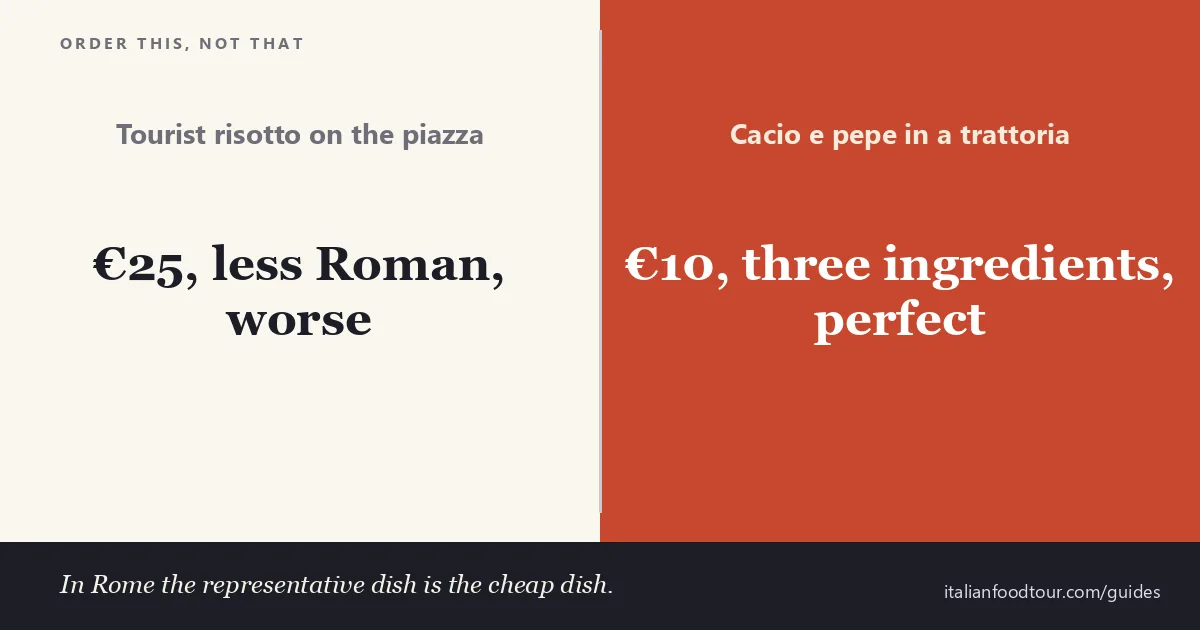
Here’s the through-line, and it’s the same one that runs through Italian restaurant etiquette: the representative dish is the cheap dish. Cacio e pepe, supplì, a slice of pizza al taglio, an artichoke in season — this is what Romans eat, it’s €2–14, and it’s the best thing on the menu. The €25 “tourist risotto” or the cream-drowned carbonara next to the monument is exactly the trap: more expensive, less Roman, worse.
The only real skill is knowing which is which — and that’s the one thing a list can’t fully teach you.
The honest shortcut
You can memorize all of this, or you can eat it in an afternoon with someone who grew up on it. That’s what a Rome food tour is: a local walks you to the trattoria that nails the cacio e pepe, the friggitoria with the supplì, the Ghetto artichoke — and tells you, plate by plate, what you’re tasting and why it costs what it costs. One afternoon and the rest of your trip orders itself.
The tourist menu is loud and everywhere. The real Roman plate is cheaper, better, and three streets away. Now you know what to put on it.
What to Eat in Rome — Quick Answers
The classic dishes, the street food, and what to skip.
Cacio e pepe (pecorino and pepper), gricia (guanciale and pecorino, no tomato), amatriciana (gricia plus tomato), and carbonara (egg, pecorino, guanciale, pepper). All four draw on the same small Roman pantry — guanciale, pecorino romano, pepper, egg, tomato — with each pasta using a different subset.
Carbonara and cacio e pepe are the signature Roman dishes. Beyond pasta, supplì (fried rice croquettes), pizza al taglio, and the deep-fried Jewish-Roman artichoke (carciofo alla giudia) are the must-tries.
No. Real carbonara is egg yolk, pecorino, guanciale, and black pepper — the silkiness comes from egg and cheese, never cream. Cream in carbonara is the clearest sign a place is cooking for tourists.
Supplì (fried rice-and-mozzarella croquettes), carciofi alla giudia (fried artichokes), pizza al taglio by the weight, fritti like fiori di zucca and filetti di baccalà, the maritozzo cream bun for breakfast, and Testaccio's quinto quarto (offal) dishes like coda alla vaccinara.
Fritti — fried starters: supplì (rice croquettes), fiori di zucca (battered zucchini flowers with mozzarella and anchovy), and filetti di baccalà (fried salt cod). They're the classic opener at a Roman pizzeria.
A cornetto (the softer, sweeter Italian croissant) with a cappuccino, taken standing at the bar. The local move is a maritozzo — a soft bun overstuffed with unsweetened whipped cream.
Cacio e pepe, pizza margherita or al taglio, carciofi alla romana (braised artichokes), fiori di zucca (ask — some are filled with anchovy), and gelato. Note that supplì and most ragù pastas contain meat, so check before ordering.
Anything that signals a tourist kitchen: cream-based carbonara, fettuccine Alfredo (an American invention), garlic bread, and the €25 "tourist risotto" parked next to a monument. Stick to the Roman classics in a real neighborhood trattoria.
Still have questions? Email us at info@italian-food-tour.com
Taste the Real Roman Plate — With a Local
The fastest way to eat the dishes that matter, at the prices Romans pay, is to go out with one. A small-group Rome food tour walks you to the carbonara, the supplì, the artichoke — the real thing, off the tourist menu. Free cancellation.
Browse Rome Food Tours