Italian Restaurant Etiquette — The Unwritten Rules Nobody Tells You
Italian restaurant etiquette, honestly: the real unwritten rules, the coperto on your bill, what to order, and the tourist clichés you can safely ignore.
Let me say the quiet part first: nobody in Italy is going to throw you out for ordering wrong. The “rules” you’ve read about — the dramatic gasps, the waiters refusing to serve you — are mostly internet theatre. What’s real is quieter and more useful: a hundred small signals that tell a waiter, in the first thirty seconds, whether you’re someone who knows the food or someone who can be sold the tourist menu. Learn a handful of them and two things happen. You eat better. And you stop overpaying for the privilege of eating worse.
Here’s what I’d actually tell a friend flying to Rome tomorrow — the rules that matter, and the famous ones you can ignore.
First, the cliché everyone repeats — and why it’s overblown
You’ve heard it: never order a cappuccino after 11am or Italians will judge you. Here’s the honest version. It’s true that Italians drink cappuccino in the morning and basically never after a meal — milk on a full stomach isn’t their thing. But the part where the whole café turns to stare? That’s a story bloggers tell each other. Order your afternoon cappuccino. You’ll get it, the barista won’t blink, and life continues.
I lead with this because it’s the fastest way to spot which guides actually know Italy and which ones are copying each other. The cappuccino panic is the tell. The rules below are the ones that do quietly register.
The rules that actually register
Parmesan does not go on seafood. This is the real one. Grated cheese on a pasta with clams, mussels, or fish is a genuine clash — the flavors fight — and asking for it is the single clearest “I don’t know this food” signal you can send. No cheese on spaghetti alle vongole, ever. (On a meat ragù or a cacio e pepe? Pile it on — that’s the whole point.)
Pasta is a first course, not a main with a side. The Italian meal has a shape: antipasto (starter) → primo (pasta, risotto, soup) → secondo (meat or fish) → contorno (a vegetable side, ordered separately) → dolce. The thing that marks a tourist isn’t ordering pasta — it’s ordering pasta as your main with a chicken breast on top. The chicken is a separate course, or it’s a different meal entirely. You absolutely do not have to order every course; walking in and getting just a primo and a glass of wine is completely normal and no one cares. Ordering chicken alfredo, though, isn’t a course problem — it’s that the dish doesn’t exist here.
Some “Italian” dishes are American. Fettuccine Alfredo, spaghetti Bolognese, chicken parmigiana as a main, garlic bread, “Italian dressing,” a bowl of olive oil and balsamic for dipping bread before the meal — none of these are on an authentic menu. If you see them, you’ve found a place that cooks for tourists. (The real Bologna dish is tagliatelle al ragù; the real bread is for the meal, not for pre-dinner dipping.)
Coffee has a price geography. Drink your espresso standing at the bar (al banco) and it’s a euro or so. Sit down at a table (al tavolo) and you pay table service — sometimes triple, especially on a famous piazza. Both prices are usually posted. Neither is a scam; you’re paying for the seat and the view. Just know which one you signed up for.
Don’t ask for a bistecca well-done. If you order the bistecca alla fiorentina, it comes rare — that’s the dish. Asking for it well-done is like asking for a flat champagne. Order something else if you don’t want rare beef.
Dinner is late, and the kitchen has hours. Lunch runs roughly 1:00–2:30, dinner from about 8:00 (earlier in the touristy north, later as you go south). Show up hungry at 6pm and your options narrow to the places that only serve tourists. Plan around the local clock and you eat with the locals.
The bill, demystified — coperto, servizio, and the tip
Here’s where people feel ripped off, almost always because of one word.
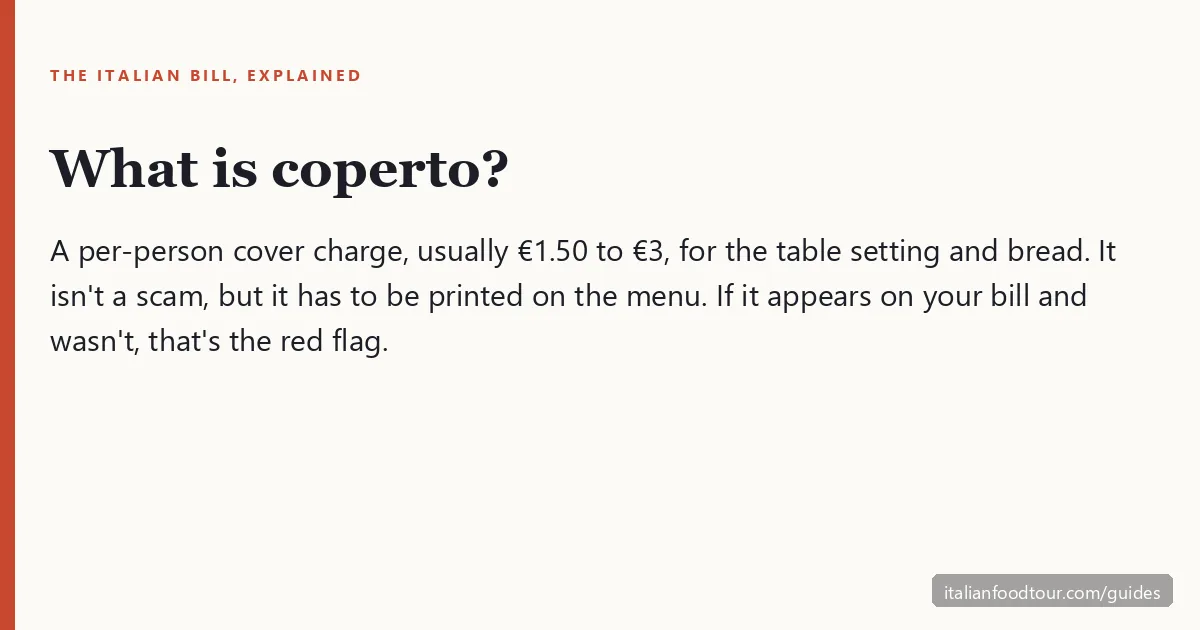
Coperto is a per-person cover charge — typically €1.50–3, occasionally up to €5 in heavy tourist zones. It covers the table setting, the bread, the act of sitting down. It is not a scam and it is not optional. The one rule: it has to be printed on the menu. If a coperto appears on your bill and was nowhere on the menu, that’s the red flag — push back. (In some places — Rome among them — you’ll see servizio or a pane/bread charge instead of the word coperto; same idea, different label.)
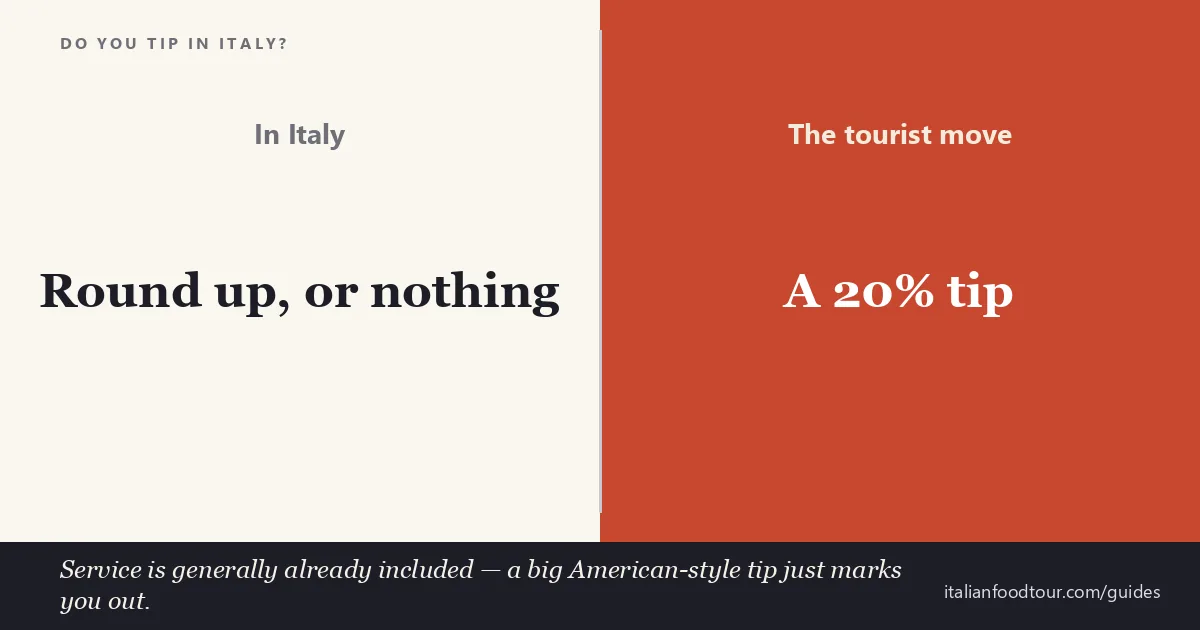
Do you tip in Italy? Short answer: no — not the way you do at home. Service is generally considered included, and you are not expected to leave 15–20%. For a normal meal you leave nothing or round up; for genuinely lovely service, a couple of euros or rounding to the next note is a warm gesture — not an obligation. Leaving a big American-style percentage doesn’t read as generous here; it reads as tourist.
Put those two facts together and most “I got overcharged in Italy” stories evaporate. You weren’t scammed. You were charged a €2 coperto you didn’t know to expect, at a place that was happy to let you not know.
The part that actually saves you money
Avoiding the rip-off isn’t really about etiquette — it’s about two decisions you make before you sit down.
- Order the dish the place is known for, where it’s cheap. Every region has a dish that’s both representative and inexpensive because everyone makes it well: cacio e pepe or supplì in Rome, tagliatelle al ragù in Bologna, pizza and cuoppo in Naples, panelle in Palermo. These are the locals’ everyday food — €8–14, not €25 — and they’re the best thing on most menus. (If you want a head start: a Rome food tour, a Bologna food tour, or a stop in Naples or Palermo is built entirely around finding exactly these.) The €25 “tourist risotto” next to the monument is where the markup hides.
- Read the room before the menu. A handwritten or short daily menu, no photos, no host outside waving you in, no menu in six languages, prices that don’t make you flinch, Italians actually eating there — that’s the place. The opposite of every one of those is the tourist trap, and they cluster exactly where you’d expect: the streets touching the big sights.
Get those two right and the coperto and the tip are rounding errors. Get them wrong and no etiquette tip will save your wallet.
The honest shortcut
You can memorize all of this — and it’s worth knowing — but there’s a faster way to make it stick, and it’s the reason I’m even able to write it down: going out once with someone who lives there.
That’s the real value of a food tour on your first day, or a cooking class where you’re talking with a local for three hours: they don’t lecture you about coperto, they just walk you two streets off the piazza to the place with the handwritten menu, point at the thing you should actually order, and let you taste why it matters. You spend one evening with a local’s eyes, and you spend the rest of the trip ordering like you belong — paying local prices, skipping the traps, and never once worrying whether the cheese goes on the clams.
The rules aren’t a test you can fail. They’re just the difference between eating in Italy and eating at the tourists’ table. One good evening with a local moves you to the right one.
Italian Restaurant Etiquette — Quick Answers
The questions everyone asks before eating in Italy.
A per-person cover charge — usually €1.50–3 — for the table setting and bread. It's not a scam, but it must be printed on the menu. If it appears on your bill and wasn't on the menu, that's the red flag.
No. It's a cover charge that goes to the restaurant, not a gratuity for your server. Tipping is separate (and, in Italy, optional).
Not the American way. Service is generally considered included, so you're not expected to leave 15–20%. Round up, or leave a couple of euros for genuinely great service — that's it.
On a seafood pasta — yes, it's the single clearest tourist signal you can send. On a meat ragù or cacio e pepe — no, go for it. The rule is cheese-on-fish, not cheese in general.
Yes — no one cares. The actual tell isn't pizza and pasta together; it's treating pasta as a main with a chicken breast on top. Pasta is a first course.
It's not a free starter — it's part of the coperto, the cover charge. (And it's for the meal, not for dipping in olive oil beforehand — that's an American habit.)
They genuinely don't drink cappuccino after a meal — milk on a full stomach isn't their thing. But the everyone-judges-you part is internet theatre. Order it; nothing happens.
Fettuccine Alfredo, spaghetti Bolognese, chicken parmigiana as a main, garlic bread — these are American-Italian inventions. If the menu has them, you've found a place that cooks for tourists.
The clearest one is cheese on seafood; after that, snapping or waving for the waiter, expecting to be rushed, or treating pasta as a side dish. None are crimes — but they quietly mark you as a visitor who doesn't know the food.
Order the regional classic (not Alfredo or Bolognese), skip cheese on fish, expect a coperto and don't over-tip, and eat at Italian hours (lunch ~1–2:30, dinner from 8). Do those five things and you blend in immediately.
Still have questions? Email us at info@italian-food-tour.com
Learn the Rules From a Local in One Evening
The fastest way to stop eating like a tourist is to go out once with someone who lives there. A small-group food tour walks you past the traps to where the food's actually good — and you'll order like you belong for the rest of the trip. Free cancellation.
Browse Italian Food Tours