How to Not Look Like a Tourist in Italy — 15 Tells That Give You Away
How to not look like a tourist in Italy: the real tells locals notice — what to wear, the coffee-bar rules, greetings, scams to dodge, and the clichés you can ignore.
Let me be honest about why this matters, because it isn’t about vanity. “Looking like a tourist” in Italy has a cost: it’s the difference between the menu with the real prices and the one with the photos, between a warm buongiorno and a shrug, between paying €1 for an espresso at the bar and €4.50 for the same cup because you didn’t know the rules. Italians aren’t judging you — most are delighted you came. But they read a hundred small signals in the first thirty seconds, and those signals decide which version of Italy you get.
So here’s the honest list: the tells that actually give you away, the ones worth fixing, and the famous “rules” you can safely ignore. Most of them have nothing to do with the dinner table — that’s a whole separate guide.
The way you dress (the #1 tell, by a mile)
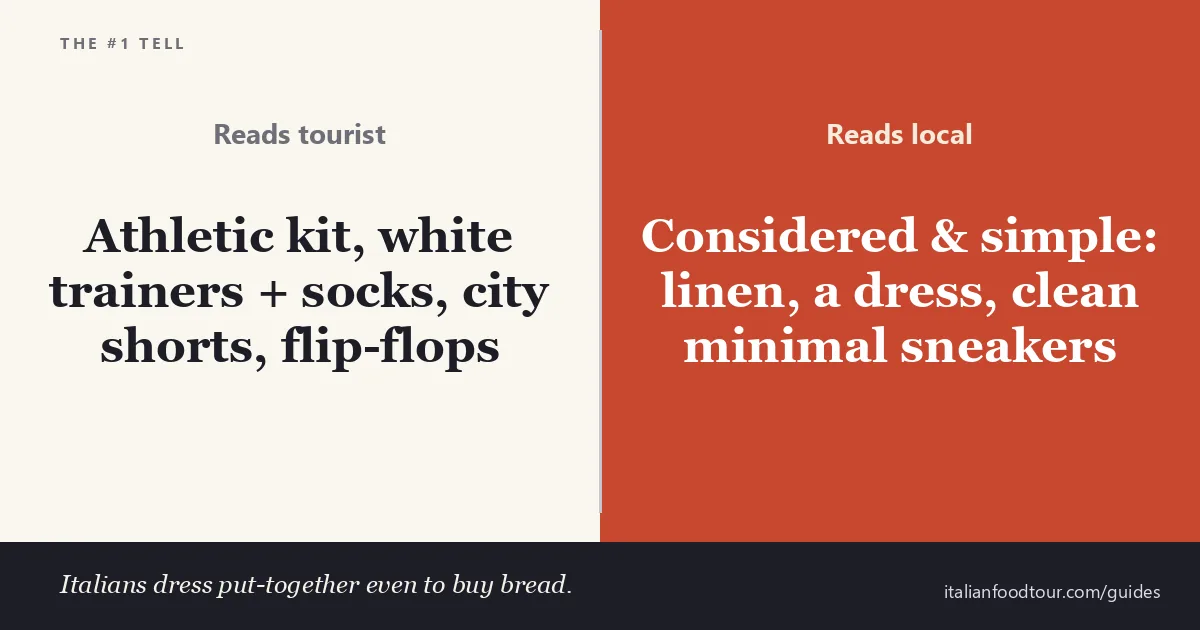
This is what people search for most, so let’s start here. Italians dress put-together even to buy bread — not formal, just considered. The tourist tells:
- Full athletic kit in the city. Chunky white trainers with white sport socks, gym shorts, leggings as trousers, a technical hiking jacket on a flat city street. Clean, minimal sneakers are fine — Italians wear them — but the head-to-toe activewear look is the loudest giveaway there is.
- Shorts and flip-flops away from the beach. In a city, grown adults rarely wear shorts, and flip-flops mean the beach, full stop. Linen trousers or a simple dress read far more local in summer heat.
- Souvenir merch and visible gear. The “I ❤️ Italia” shirt, the money belt worn over your clothes, the giant backpack on your front, the baseball cap and lanyard. All of it announces “tourist” before you open your mouth.
- Bare shoulders and knees at churches. This one has teeth: major churches (St Peter’s above all) will turn you away at the door if your shoulders or knees are uncovered. Carry a light scarf — it doubles as a cover-up and looks the part.
The coffee bar (the second-biggest tell)
The Italian bar has its own grammar, and tourists trip on it daily:
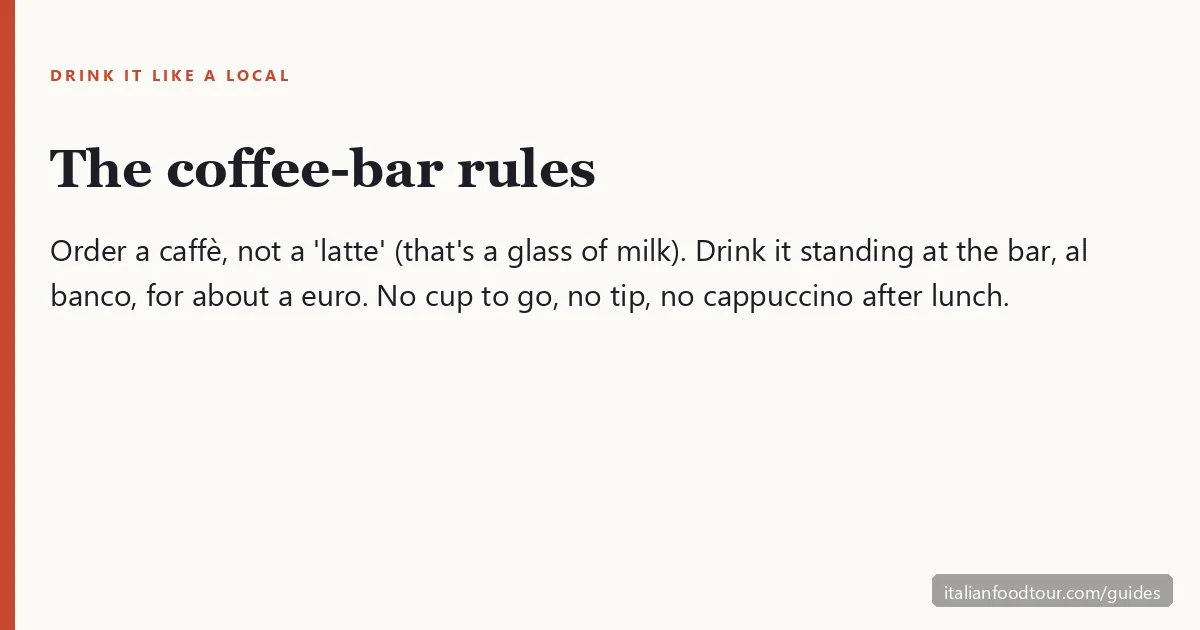
- Ordering a “latte.” Say latte and you’ll get a glass of warm milk — because that’s what the word means. You want a caffè latte, or just a cappuccino.
- Asking for coffee “to go.” Takeaway cups barely exist. Coffee is a 90-second ritual taken standing at the bar, al banco. Order, drink, go.
- Not knowing the standing-vs-sitting price. An espresso al banco runs about €1–1.50; sit at a table (al tavolo) and you pay table service, sometimes several times more. Both prices are posted by law. Neither is a scam — just know which you chose.
- Tipping the barista, or a cappuccino after lunch. No one tips for a counter coffee (leaving the small change is the most you’d do), and Italians simply don’t drink milky coffee after a meal. The “everyone will stare” version of that rule, though, is internet theatre — order your afternoon cappuccino, nothing happens.
Greetings and volume
- Skipping the buongiorno. Walking into a shop, bar, or restaurant and launching straight into English — or straight into your request — reads as rude. A simple buongiorno (or buonasera after ~4–5pm) on the way in and grazie, arrivederci on the way out does more for how you’re treated than fluent Italian would.
- Being loud. The single most-cited “obnoxious tourist” behavior abroad is volume — Italians converse animatedly but rarely broadcast across a quiet restaurant or a train carriage. Match the room.
The dinner table (briefly — it has its own guide)
I’ll keep this short because the restaurant etiquette guide covers it in full, but the headline tells: cream in the carbonara (there is none), parmesan on a seafood pasta, ordering chicken Alfredo or spaghetti Bolognese (American inventions), and showing up to dinner at 6pm when kitchens open at 7:30–8. For what to order instead, see what to eat in Rome; for the bill, do you tip in Italy.
Money and the classic scams
- Over-tipping. A 20% American-style tip doesn’t read as generous — it reads as someone who didn’t know. Round up; that’s it.
- Paying €3 for bottled water. Italian tap water is excellent, and the cast-iron street fountains (Rome’s nasoni) pour cold, free, drinkable water. Carry a bottle.
- The street setups. The “free” rose pressed into your hand (then payment demanded), the friendship bracelet tied onto your wrist, the costumed “gladiators” at the Colosseum who charge for photos, the clipboard “petition” that’s a pickpocket distraction. A firm no, grazie and keep walking — and keep a hand on your bag in crowded squares.
Getting around
- Not validating your train ticket. On regional trains, a paper ticket must be stamped in the green-and-white machine on the platform before you board — skip it and an inspector can fine you, “but I didn’t know” included. (Buy the e-ticket in the Trenitalia app instead and you “check in” within the app before departure — no machine. High-speed Frecce/Italo tickets carry an assigned seat on one specific train and need neither.) And if you’re driving: most historic centres are ZTL limited-traffic zones — entering without a permit mails you an automatic camera fine weeks later, and the active hours vary by city, so don’t assume a quiet evening means it’s off.
Timing your day like a local
- Fighting the rhythm. Lunch is ~1–2:30, dinner from 8. Many shops — especially in smaller towns and the south — close for a midday riposo, roughly 1–4pm. Lots of things shut on Sundays, and much of the country empties for Ferragosto in mid-August. Plan with the clock instead of against it and you stop running into locked doors.
The point isn’t to “pass” — it’s to be let in
Here’s the reframe, and it’s the honest one: you don’t need to fool anyone. Italians are warm to visitors who show a little care — a buongiorno, an attempt at the language, a willingness to eat what’s actually local. The goal isn’t camouflage; it’s respect, and the better trip that earns you.
And the fastest way to absorb all of this isn’t a checklist — it’s a few hours with a local. That’s the quiet value of a food tour or a cooking class on day one or two: you watch how they order their coffee, greet the shopkeeper, pick the dish, round up the bill — and you spend the rest of the trip doing it by instinct. You stop standing out at the table, and you stop paying the tourist price for the privilege.
You’ll still get spotted as a visitor — your accent will out you in a second, and that’s completely fine. The point was never to disappear. It was to be treated like a guest instead of a mark.
Not Looking Like a Tourist in Italy — Quick Answers
What to wear, what to skip, and the rules locals actually notice.
Dress put-together (skip head-to-toe activewear, city shorts, and flip-flops), say buongiorno when you enter somewhere, take your coffee standing at the bar, don't over-tip, and eat at Italian hours. None of it is hard — it's just different from home.
Full athletic kit in the city (gym clothes, chunky white trainers with white sport socks), shorts and flip-flops away from the beach, souvenir merch, and a money belt worn over your clothes. And cover your shoulders and knees if you want to enter the major churches.
Yes — clean, minimal sneakers are completely normal and Italians wear them. It's the chunky white athletic trainers (especially with white sport socks and gym clothes) that read as tourist, not sneakers in general.
Volume above all, plus head-to-toe athleisure, ordering a "latte" or a coffee to go, big percentage tips, baseball caps and lanyards, and walking into a shop without a buongiorno.
Don't order a "latte" expecting coffee (you'll get milk), don't tip 20%, don't skip validating a regional train ticket, don't wear beachwear in cities, and don't show up to dinner at 6pm — kitchens open around 7:30–8.
Generally, yes. Italians are warm to visitors who show basic respect — a greeting, an attempt at the language, a willingness to eat local. It's rudeness and loudness, not nationality, that wears thin.
Greet when you enter a shop or bar, take coffee standing at the counter, dress considered rather than sporty, no parmesan on seafood pasta, validate your regional train ticket, and keep your voice down indoors.
Decline the "free" rose or friendship bracelet, ignore the costumed photo-chargers near big sights, keep a hand on your bag in crowded squares, and avoid restaurants with photo menus and a host waving you in on the main piazzas.
Still have questions? Email us at info@italian-food-tour.com
Learn the Codes in One Afternoon — With a Local
You can't read your way to blending in — you absorb it. A few hours with a local on a food tour or cooking class and you pick up the rhythm by osmosis: how they order, greet, eat, and pay. You stop standing out, and you stop getting the tourist price. Free cancellation.
Browse Italian Food Experiences